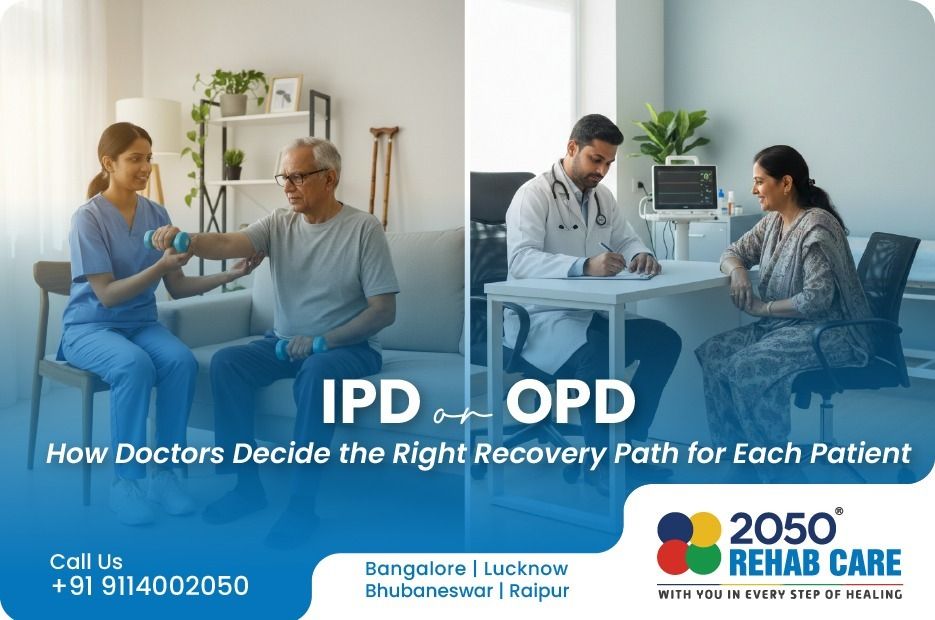
IPD or OPD: How Doctors Decide the Right Recovery Path for Each Patient
Published on 2/5/2026Recovering from an illness, injury, or surgery is often more challenging than the treatment itself. Many patients face reduced mobility, fear of slow or incomplete healing, and genuine confusion about what kind of care they truly need after being discharged. Families frequently feel overwhelmed too, and hence, get unsure whether managing recovery at home will be sufficient or whether hospital-based rehabilitation would be safer and more effective. One question patients and caregivers ask doctors again and again is both simple and critical: “Should I continue my recovery through OPD visits, or do I need admission for IPD care?” Understanding how doctors arrive at this decision can bring much-needed clarity, confidence, and peace of mind during one of the most vulnerable phases of the healing journey.
Understanding OPD and IPD in Recovery Care
Before exploring the decision-making process, let’s clearly define what these two terms mean in the context of recovery.
What is OPD Care?
OPD stands for Outpatient Department. This type of care allows patients to receive medical attention without being admitted to the hospital. Patients typically: ●︎ Visit doctors and specialists for consultations ●︎ Undergo diagnostic tests (blood work, X-rays, scans) ●︎ Attend physiotherapy, occupational therapy, or other rehabilitation sessions ●︎ Return home the same day after treatment
In recent years, multi-speciality OPD services in India have become increasingly sophisticated. Many hospitals now offer coordinated care under one roof, bringing together specialists in orthopaedics, neurology, cardiology, general medicine, and physiotherapy. This makes OPD an efficient and structured option for patients who are medically stable but still need professional guidance.
What Is IPD Care?
IPD stands for Inpatient Department, meaning the patient is admitted to the hospital for a period of time. IPD care is designed for individuals who require: ●︎ Continuous monitoring by doctors and nurses●︎ Assistance with daily activities (bathing, dressing, walking)
●︎ Frequent medical interventions or medication adjustments
●︎ A controlled environment to minimize risks during recovery
For patients focused on rehabilitation, IPD often includes dedicated rehabilitation units where structured therapy, round-the-clock nursing support, and medical oversight happen in a safe, supervised setting.
The Growing Role of OPD in Modern Recovery
The whole of mankind is grateful for the advancements in outpatient services; many patients who once required hospital admission can now recover effectively through well-organized OPD programs. Multi-speciality OPD centres in India have made it possible to deliver high-quality, coordinated care without long hospital stays. This approach works particularly well for:
●︎ Early-stage recovery after minor surgeries or injuries ●︎ Management of chronic conditions (e.g., arthritis, diabetes-related complications) ●︎ Follow-up care and preventive rehabilitation
OPD allows patients to maintain their home routine while still receiving expert guidance, which can improve emotional well-being and reduce costs. With these modern options in mind, let’s look at how doctors decide which path is most appropriate for each individual.
How Doctors Decide Between IPD and OPD Recovery
Doctors never use a one-size-fits-all formula. Instead, they carefully evaluate a combination of medical and practical factors to recommend the safest and most effective recovery path.
Medical Factors
1. Severity and Stability of the Condition
The first and often most important consideration is how serious the patient’s condition is and how stable they are. Patients with mild to moderate issues- such as early-stage knee or shoulder pain, stable post-stroke weakness, or routine follow-up after a minor procedure - are usually guided toward OPD care. They can attend scheduled appointments and therapy sessions while living at home. On the other hand, patients recovering from major events—such as a recent stroke, complex fractures, spinal injuries, major abdominal or cardiac surgeries, or severe neurological conditions—often need the close supervision of IPD care. In these cases, small changes in health can escalate quickly, and being in the hospital allows doctors to respond immediately.